
A newer jumper recently related that he had experienced a rocking back and forth in freefall, and that his instructor had used the phrase, “potato chipping,” to describe the motion. This potato chip motion happened during normal freefall early in AFF and again during a few coached track jumps.
While everyone’s situation is different, this “chipping” motion is almost always a result of the body being held too rigidly. Air blasts off the plank and tips it one way, then the blast hits the other way and tips it back again the opposite way. If the core tries to compensate it can sometimes increase the action further. Instructors usually say “relax.” But what does that mean? Let’s get specific!
Potato chipping can happen to anyone, and it tends to happen during transitions —turns, docking, tracking or even during the pull sequence.
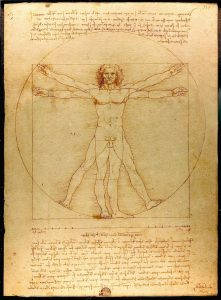
The above is a very well-known image called the “Vitruvian Man,” an illustration created by Leonardo DaVinci, way back in 1490. Among other things, it is meant to explore the ideal geometric proportions of a human being. I think it holds a little secret we can use in this case. Notice the center of the image falls upon a spot just below the navel. This is also about the physical center of most human beings. And when you are in the belly-to-Earth freefall position, this point is your ideal center of gravity…or, if you think of the human body as a badminton bird (aka shuttlecock), this “point” is the ideal center of your arch position.
If we can focus on our center of gravity and relax the rest of the body around this point, we can be stable in freefall. When we’re relaxed, we are naturally more sensitive to the feeling of the air moving around us, and we can more easily respond to it. This is dynamic stability.
Did you know?
Exercises that focus on strengthening your core can greatly improve your awareness and sense of control in freefall. Don’t skip core day!

Freefall is like driving down the interstate…
Visualization: Imagine that you’re driving down the interstate with the cruise control engaged. You’re relaxed, having done this many times. Think about where your hands would be, and what they would be doing. Are they locked onto the steering wheel in a death-grip, elbows locked? Are you stiff as a board? Or, are you making radical movements? No. You are gently adjusting your direction of travel… relaxed.
The point of this visualization is to help us understand what’s really happening when we’re driving like this – so we can translate it to freewill. If you reflect upon driving down the interstate, you can sometimes think the car is kind of driving itself. Your job is to make minimal corrections to maintain your direction.
Freefall works in a similar way. If we’re stiff in freefall it’s like a death-grip on the steering wheel. It is useful to remember: Freefall will take care of itself – your task is to relax and move as smoothly as possible —making minimal corrections to maintain dynamic stability.
Slow is Smooth, Smooth is Fast
So how do I apply this? Practice. We’ve all heard the phrase, “Slow is smooth. Smooth is fast.” If not from a skydiving instructor, maybe while training in some other type of sport. It means that we need to practice slowly in order to develop smooth movement. Once we’ve fully trained the move, we can increase the speed at which it happens. Less errors occur.
We can use this principle as we train for any type of transitional move. I believe practice is particularly important for the wave-off and pull sequence. We want to avoid making any extra movement that might send us into a turn or cause us to dive as we reach for the handle. Also, if we stiffen in this sequence we may potato chip!
Or, let’s explore the transition to tracking while on the ground:
- Assume the arched position while standing
- Let your head roll back, so that you can kind of see behind yourself.
- Extend your legs, to start the forward movement.
- Sweep your arms back and hold for more lift.
- De-arch, to catch more air.
- Bonus Points: Shrug your shoulders and drop your chin to “cup” the upper body.
Allow yourself to feel the individual moves. Repeat it. This is much more effective than just expecting yourself to assume the optimal flat track position all at once. You are more likely to potato chip. Experience how each movement feels when you do it. Then, practice while wearing a rig and your helmet. Simulate as much as you can – pay attention to how the rig moves, or how it might restrict your movements.
Practicing the individual movements will allow you to execute them in sequence —bringing them together into one fluid movement. The individual steps will seem to disappear as you slow it down and smooth it out. This kind of practice is effective in almost any discipline that requires precise movement. Practice can help build real confidence in our ability to perform!
Remember: Slow is smooth, smooth is fast – this is how you “get there!”